
Build over drain survey
The CCTV survey and report Severn Trent require before you build over or close to a public sewer. Extensions, conservatories and garages.
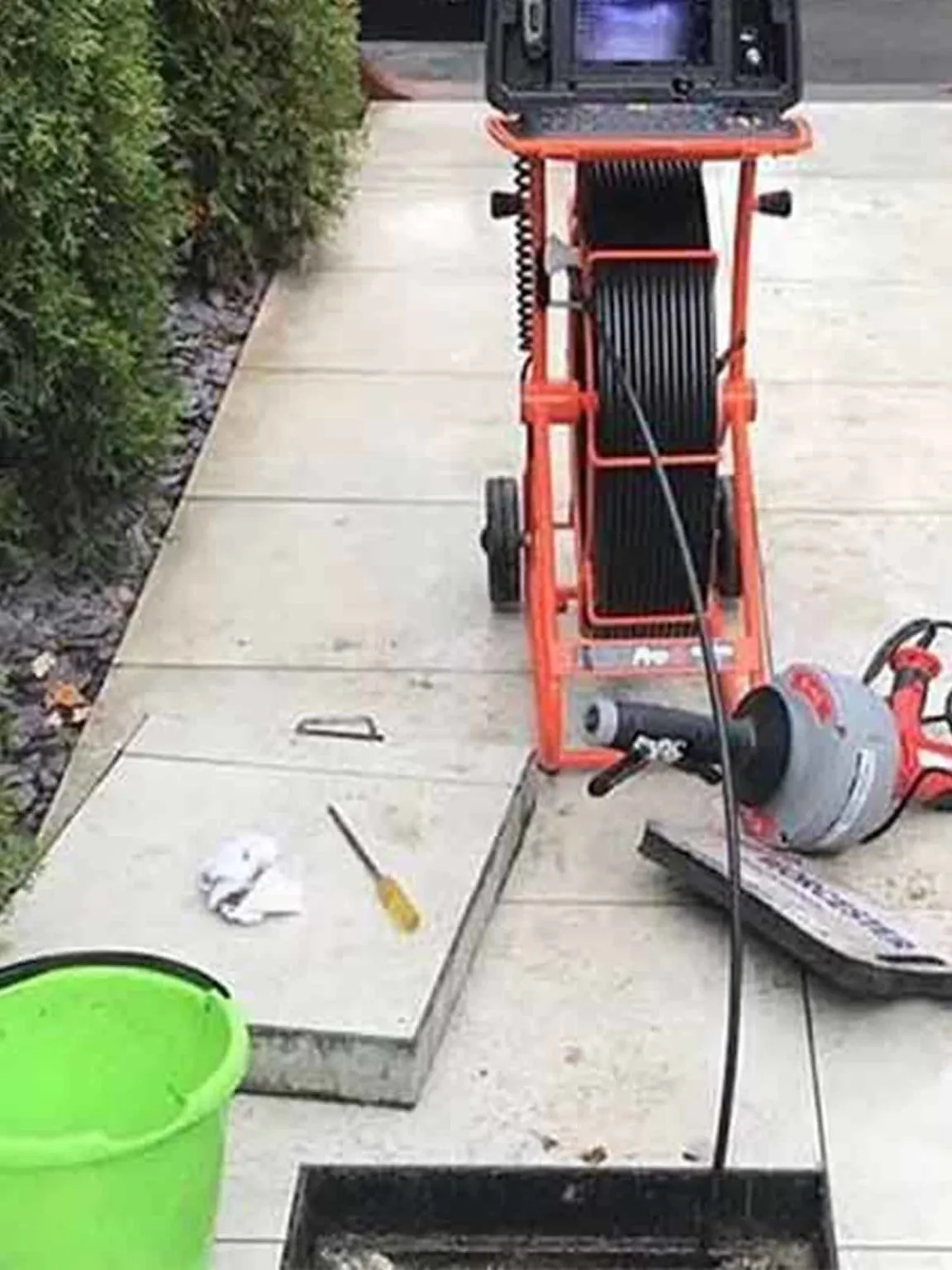
A build over drain survey is the closed-circuit television (CCTV) inspection Severn Trent asks for. You need it before you build over, or close to, a public sewer or lateral drain. That is usually for an extension, conservatory or garage. It records the pipe's condition, position and depth. That way your application can be self-certified, or approved under a formal build over agreement.
Your architect, Building Control or Severn Trent has asked for a build over survey before the extension can go ahead. This page sets out what the survey records. It covers which of the two approval routes your extension is likely to take. And it covers what we hand over for the application.
A build over drain survey is the closed-circuit television (CCTV) inspection Severn Trent asks for. You need it before you build over, or close to, a public sewer or lateral drain. That is usually for an extension, conservatory or garage. It records the pipe’s condition, position and depth.
That way your application can be self-certified, or approved under a formal build over agreement. Drainage Emergency carries them out from Mansfield Road, DE21, across Derby, Derbyshire and Nottinghamshire.
When you need a build over survey
You need a build over survey when you are putting up an extension, conservatory, garage or any structure with foundations. This applies if it sits over a public sewer, or close to one. The general rule in England is that building over a public sewer or lateral drain needs the sewerage company’s agreement first. The same is true if you are building close to one.
A lateral drain is the length of your own drain that lies beyond your boundary. It is on its way to the sewer. In Derby the company is Severn Trent Water, and their own form sets out how close is too close. Building Control will ask whether you have the agreement.
What catches owners out is which pipes count. Since the 2011 transfer of private sewers, any drain shared between two or more properties is a public sewer. So is most pipework beyond your boundary. In a terrace the drains often run along the backs of several houses.
On an estate with shared drives, the pipe in your garden might seem to be yours. Very often, it is Severn Trent’s. The survey settles it.
It does so before the architect finishes the drawings, which is when it is cheapest to move a wall. Call 01332 215521 with the address and we survey the run before the design is fixed.
The survey itself is a CCTV inspection of the sewer or drain under the proposed footprint. Its position, depth and condition are recorded. That way, Severn Trent can see what you intend to build over, and whether it is sound.
Self-certification or a formal build over agreement
Severn Trent run two routes. Self-certification is for a single existing domestic property having a domestic extension over a smaller public sewer or lateral drain. The size limit is on their form. You complete a declaration and pay the fee set out on the form. If you can honestly tick every box, you can proceed without waiting for them to review the design.
The boxes are specific, and they fall into three groups. The figures behind them (pipe size, depth and clearances) are on Severn Trent’s self-certification form. That is the document to check, because they can change it.
About the pipe: it has been shown to be in good condition by a CCTV survey. Or you will replace the whole built-over length. It is clay or plastic, not pitch fibre.
It is a gravity foul, storm or combined sewer, not pressurised. Its invert, the bottom of the pipe, is no deeper than the form’s depth limit. It also does not change diameter, direction, material or gradient under the footprint.
About access: there are no manholes inside the footprint. None will be added, removed or moved. And the building keeps the required clearance from any manhole, inspection chamber or rodding eye.
About the building: the foundations are strip or trench fill, not piled or raft. They keep the required clearance from the pipe. The exception is where the pipe passes through a load-bearing wall and is protected in line with the Building Regulations. You are not aware of any history of blockages, flooding or odour on that sewer.
Nor are you aware of easements that prohibit the work. And the extension does not run from boundary to boundary. That is, where the neighbours on both sides have already done the same.
If any of those is not true, you need the formal build over application instead. Severn Trent also require the formal route when the sewer is larger than the self-certification limit. They also require it when a manhole has to be moved, altered or built over. That application goes in with your building plans, the CCTV survey (unless you are replacing the pipe) and the application fee. Severn Trent then review the design before you can start.
What the pre-construction CCTV survey records
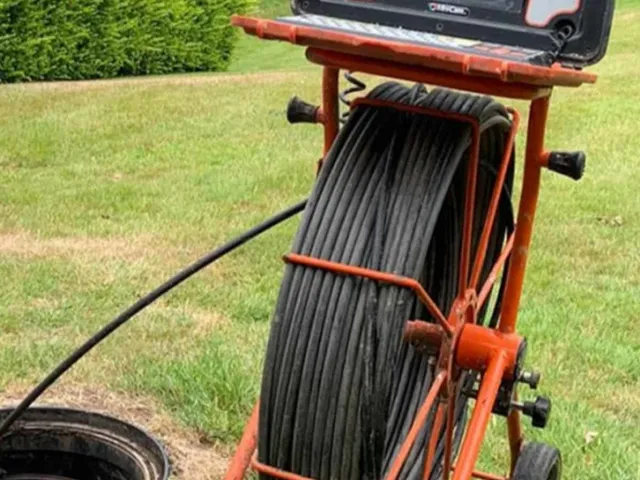
The engineer opens the nearest chamber and runs the camera along the sewer under and around the proposed footprint. Distance is counted from that chamber, so every joint, connection and defect is placed to the metre. A sonde is a small transmitter in the camera head. It lets the engineer locate the pipe from the surface with a receiver.
Its line and depth are marked on the ground. That is what the architect needs to plot it on the drawings. It is also what the builder needs before the digger arrives.
The recording shows the material (clay, plastic, concrete or pitch fibre), the diameter and the direction of flow. It also shows whether any of those change beneath the footprint. That last point is one of the self-certification questions. Condition goes on record too: intact, cracked, displaced at a joint, root ingress, or a dip that holds water. Depth to invert is measured at the chambers and at the sonde readings.
That goes into a written report with the footage, laid out against the self-certification checklist. You and your architect can see at once which route you are on. You send the report to Severn Trent with the application. Where an extension footprint contains more than one run, foul and surface water for instance, each is surveyed and reported separately.
Defects found before you build
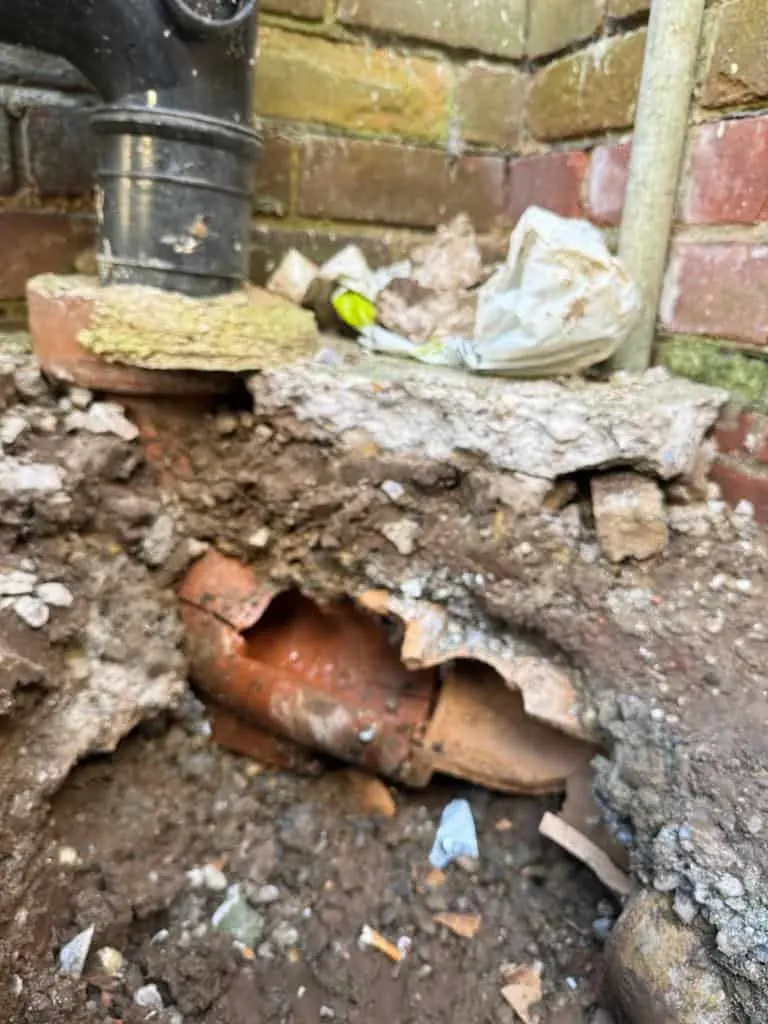
Sometimes the camera finds a problem: a cracked length, an open joint, roots, a dropped section. That is the survey doing its job, because Severn Trent’s consent depends on the pipe being sound. Their self-certification form is explicit that consent is invalid if the condition was not established or defects were not repaired. Liability for putting the pipe right rests with the applicant.
Find it now and it is a repair. Find it after the slab is poured and it is a repair under your new kitchen.
Most defects can be fixed from inside the pipe. A patch cures a resin sleeve over a single crack or joint. A reline forms a new pipe inside the old one, along a longer run.
Both are described on the drain repair page and neither needs the pipe dug up. Where the sewer has collapsed, or the material is pitch fibre, which self-certification rules out, replacement is the route. Replacing the whole length under the footprint is itself accepted by Severn Trent in place of a survey.
The repair is followed by a second camera run.
That way the application carries footage of a sound pipe. If a survey by someone else has already found a defect, call 01332 215521. We quote the repair from their footage, and film the pipe again afterwards.
The post-construction survey
When the build is finished, Severn Trent require a CCTV survey report. It confirms the sewer has not been damaged by the works. The camera goes back along the same run, and the footage is compared with the pre-construction survey. If the builder has kept the clearances, and protected the pipe where it passes through the wall, the two recordings match.
Severn Trent can then close the application. A joint might be displaced by the foundation trench, or a length crushed by machinery. Either way, the applicant pays for the repair.
Booking the same firm for both surveys helps. The second engineer knows exactly which chamber to start from, and what the pipe looked like before. Keep the post-construction report with the house papers.
A buyer’s solicitor will ask for the build over consent. The pair of surveys is what shows the work was done properly. For the buyer’s side of that, see the pre-purchase drain survey page.
Build over surveys across Derby’s extension suburbs
Rear extensions are the usual trigger, and Derby’s back gardens are where the drains run. Chaddesden, DE21, is a few minutes from our office on Mansfield Road. Its 1930s to 1960s semis have long back-garden runs to a rear gully.
So a single-storey extension frequently sits directly over the drain. Allestree, DE22, around Allestree Park, and Littleover, DE23, towards Burton Road, have the larger plots and the mature trees. A build over survey there often finds the root ingress that would have invalidated a self-certification.
Mickleover, DE3, has the shared drives and long private drains of a 1960s-onwards suburb. So the first question there is ownership. A drain shared with next door is a public sewer, and needs the application.
A drain serving only your house does not. In the Victorian terraces of Normanton, DE23, the drains run along the backs of the row and the boundary-to-boundary rule bites. If both neighbours have already extended across the full width, self-certification is off the table.
Darley Abbey, DE22, adds a further layer. It is a conservation area with the oldest drainage in the city. There, a defect found before building is fixed by lining, rather than by digging up a Georgian yard.
What to have ready when you call
Have the address, a rough description of the extension, and the architect’s drawing if there is one. A sketch with the footprint marked is enough to start. If you know where the chambers are, say so. If you do not, finding them is part of the survey.
When you call you speak to the drainage firm that does the survey, not a booking desk. We are at 33a, Parker House, Mansfield Rd., Derby DE21 4SZ. We cover Derby, Derbyshire and Nottinghamshire, 24 hours a day, 365 days a year.
You get the price before we start. There are no hidden fees on quotes. We carry £5 million public liability insurance.
The engineers are fully qualified drainage engineers. They carry out the general CCTV drain survey work, as well as build over surveys. If the camera finds a defect, the same firm repairs it and films it again.
Call 01332 215521 before the drawings are final. The sewer will be on them, and so will the route to Severn Trent’s consent.
Recent build over drain survey work in Derby
Around Derby: where this work comes from
We are based at Parker House on Mansfield Road (DE21), on the east side of the city. Every area below is one we attend regularly, and the notes are what our engineers actually find there.
Areas we cover for this service
- Normanton and Rose HillDE23
Dense late-Victorian terraces around the Arboretum, most on their original salt-glazed clay drains with rigid joints. Shared runs between neighbours are common, which is why a blockage in one house can show up next door first.
Directions from our office - ChaddesdenDE21
Mostly 1930s to 1960s semis on the east side of the city, a few minutes from our Mansfield Road office. Original clay drains and long back-garden runs to a rear gully are typical.
Directions from our office - AllestreeDE22
Leafy 1930s to 1960s suburb on the north side with large gardens and mature trees, so root ingress into clay drains is the most common survey finding.
Directions from our office - MickleoverDE3
Derby's largest suburb, mainly 1960s onwards with newer estates on the western edge. Long private drains to the adopted sewer and plenty of shared drives, which affects who is responsible for a blockage.
Directions from our office
Local landmarks nearby
- Darley Abbey MillsDE22
Cotton mills founded by the Evans family in 1782, now part of the Derwent Valley Mills World Heritage Site. The surrounding mill village is a conservation area, so repairs that avoid digging are the first choice.
Directions from our office - Allestree ParkDE22
The largest park in Derby, now being rewilded. The mature-tree suburb around it is where CCTV surveys most often find root ingress.
Directions from our office - Chaddesden ParkDE21
A few minutes from our Mansfield Road office. Most of the east-Derby callouts start from here, which is why Chaddesden, Oakwood and Spondon get the fastest attendance.
Directions from our office
Whose drain is it? Severn Trent owns and maintains the public sewers in Derby. Since the 2011 transfer of private sewers, most pipework beyond your boundary became theirs. So did shared drains serving more than one property. The drain that serves only your property, inside the boundary, remains yours. If you are not sure, call us on 01332 215521 and we will tell you before anyone is sent out. Full coverage list on our service areas page.
Questions people in Derby ask about build over drain survey
What happens if I build over a sewer without an agreement?
Building Control can withhold sign-off, a buyer's solicitor will ask for the consent when you sell, and if the sewer under the building is damaged or blocks, the repair and the access are your problem rather than Severn Trent's. A survey and an application before the slab goes down is far cheaper than any of those.
How much does a build over agreement cost?
Severn Trent charge an application fee, which is set out on their self-certification form and their formal application, and the two routes are priced differently. The survey itself is quoted by us before we start, with no hidden fees on quotes, and the price depends on how many runs sit under the footprint.
Is it illegal to build over a manhole?
You cannot self-certify a build with a manhole inside the footprint, and Severn Trent require the formal build over application whenever a manhole has to be moved, altered or built over. The usual outcome is a redesign that keeps the building clear of the chamber by the distance given on Severn Trent's form, or a relocated manhole agreed with Severn Trent.
Is a CCTV drain survey required for a build over agreement?
Yes, unless you are replacing the whole length of pipe under the building. Severn Trent's self-certification declaration asks you to confirm the pipe is in good condition as shown by a CCTV survey, and the formal application asks for the survey to be submitted with the plans.
Do I need a build over survey for a conservatory or garage?
If it has foundations and sits over or close to a public sewer or lateral drain, yes, and Severn Trent's form gives the distance that counts as close. Their own self-certification form lists conservatories and garages alongside rear, side and front extensions as the developments it covers.
How long does Severn Trent take to approve a build over?
Severn Trent review a formal build over application once the plans, survey and fee are in, and they set the timescale, not us, so check their application page for the current figure. Self-certification is quicker because, if every declaration is met, you can proceed without a design review. Our survey is booked around your build programme.
What Derby customers say
★★★★★Excellent service. Came within an hour of being called. Sorted out my drainage problem with 30 minutes too. Was very thorough in his investigation and solution. Would definitely use again if the need arises
Mark Tabberer
★★★★★Can’t fault this guy came over within an hour. Main drainage was all blocked sorted it in no time cleaned all up gave me good advice. And a good price what more can you ask.thank you.
Craig
★★★★★Call out over the weekend. Attended within 30 mins. Professional service and issue resolved quickly. Would highly recommend.
Danny Davies